Travelling solo in a motorhome is one of the most liberating experiences there is, and more and more people are choosing to do it. What people rarely tell you is that the biggest obstacle is not solitude or the route itself: it is the preparation beforehand. Those who set off well prepared enjoy the journey from the very first mile; those who improvise end up managing setbacks instead of enjoying the scenery. In this article, you will find everything you need to know about safety, organisation and where to find the best quiet places to stay overnight.
The motorhome offers something no other means of transport can: you take your own bedroom, kitchen and bathroom with you. That instantly removes the usual concerns of the solo traveller, such as finding last-minute accommodation, relying on timetables or sharing spaces with strangers in a hostel.
Travelling alone in this type of vehicle also means that you decide absolutely everything: when to stop, how long to stay somewhere and when to move on. There are no negotiations, no compromises. That complete freedom is, for many, the main reason for choosing this way of travelling.
Safety on a solo trip depends far more on preparation than on luck. With a few well-applied measures, the vast majority of risky situations can be easily avoided. Preparing means protecting yourself.
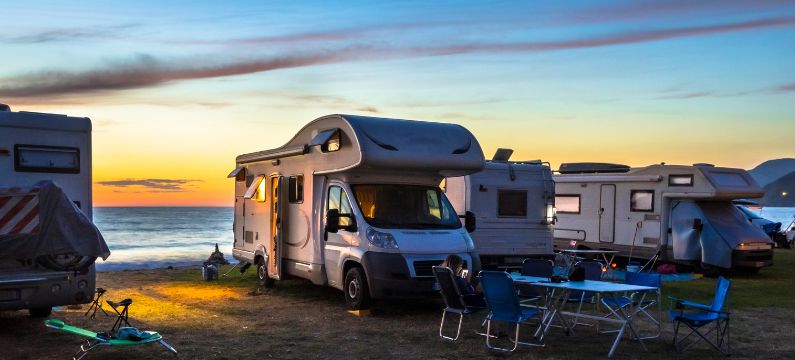
When travelling alone, the main criterion for choosing where to stay overnight should be the visibility and activity in the surrounding area. Places with other motorhomes nearby are always a positive sign: the presence of more vehicles acts as a deterrent and also creates an informal support network between travellers.
Avoid parking in isolated places you do not know, especially on the outskirts of towns and cities. Natural settings, official service areas and campsites offer far more peace of mind than industrial estates or empty open spaces with no clear reference points.
Keep the doors locked at all times when you are inside, even during the day. Keep the blinds or curtains closed at night. Store valuables out of sight when you step away from the vehicle. And always let someone you trust know your approximate location: a daily message with the area where you stayed overnight is a simple habit that brings great peace of mind, both for you and for the people who care about you.
Travelling as a couple or as a family naturally divides the tasks: one drives, another navigates, one cooks while the other manages the tanks. When travelling alone, everything falls to the same person, and that requires a little more organisation.
Develop a departure routine that you always follow in the same order: check the fresh and waste water tanks, put away the outdoor table and chairs, secure the interior cupboards, make sure the gas is turned off and check the lights. With practice, this routine takes no more than ten minutes and saves you from unnecessary stops halfway through the journey.
Cooking for one in a motorhome is convenient and cost-effective. The key is to plan your shopping a little in advance so that you are not relying on finding a supermarket at every stop. Keeping a small reserve of non-perishable food at all times gives you the flexibility to change plans without hunger driving the decision.
When you travel with someone else, there is always somebody who can help if something goes wrong. On your own, it is worth understanding the basics of the leisure battery, how to connect and disconnect the water hose, and how to empty the waste water tanks. You do not need to be a mechanic: knowing the essentials for day-to-day use is more than enough.
One of the great advantages of travelling alone is that you can choose quieter, less crowded destinations without having to convince anyone else. A motorhome gives you access to places that would be difficult to reach with other types of accommodation.
Natural parks and mountain areas offer some of the best experiences for a solo traveller. Noise levels are minimal, the sense of privacy is high, and the surroundings invite you to switch off properly. In Spain, regions such as Aragon, Castile and León, and Andalusia are home to some of the most beautiful and least crowded areas to explore by motorhome.
Many towns with fewer than five thousand inhabitants have set up motorhome service areas with electric hook-up, waste disposal and water supply. They are ideal places for a solo traveller: peaceful surroundings, basic services covered, and the chance to stroll through the town and connect with local life.
Travelling alone does not mean being isolated. The motorhome travel community is especially open and supportive. In overnight areas, it is common for other travellers to say hello, share information about the area or lend a hand if something is not working. Taking part in motorhome forums and groups before the trip also allows you to gather first-hand recommendations on routes and safe places.